 oakenbit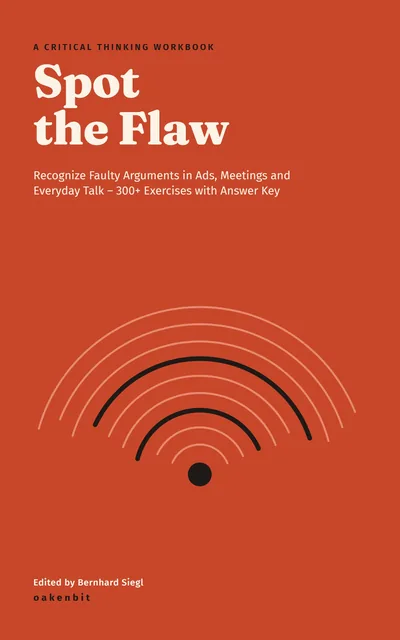
“Thousands of customers can't be wrong.” “We've always done it this way.” “Sales up 400 %!” Every day someone tries to convince you of something – in ads, meetings, family chats and headlines. Most arguments are fine. Some only look convincing. This workbook trains you to tell the difference – calmly, fairly and with plenty of practice.
Part 1 shows what an argument is – claim, reasons and the hidden assumption between them – and starts with a self-test. Part 2 explains 24 common flaws in five families, each with a plain name, its textbook or Latin name, a typical example and one question that exposes it. Part 3 mixes everything: tests without hints, longer texts with several flaws, and advice on how to respond without starting a fight.
No politics, no religion, no real people or brands – just clear thinking for everyday life. In the paperback there is room to write in every worksheet; in the e-book, every worksheet is a numbered list linked to its answers.
What is inside
- 24 flaws in five families: relevance, evidence, cause and consequence, language and structure, numbers and chance
- 300+ exercises with invented everyday examples: name the flaw, match, multiple choice, sound or flawed, rewrite the argument fairly, write a calm reply
- Plenty of sound arguments too, so you learn not to see flaws everywhere
- A self-test, six mixed tests and three longer texts – a team meeting, a flyer, a forum thread
- A four-week plan, a complete answer key that explains every answer, and a quick reference with all 24 flaws
Details
- Language
- English (American spelling)
- Paperback
- 96 pages, 6 × 9 in (15.2 × 22.9 cm), 36 worksheets, 313 exercise items
- Kindle e-book
- Every worksheet a numbered list linked to its answers, for use with a notebook
- Prices on Amazon.com and Amazon.co.uk
- Paperback $12.99 / £9.99, Kindle e-book $4.99 / £3.99
- Author
- Edited by Bernhard Siegl
- Production
- Text generated by an AI system; cover and graphics drawn by program code